Discreet Appearance
The transparent trays are less noticeable than metal brackets and wires, which can suit adults and teens who feel self-conscious about visible orthodontic appliances.
Serving Atlanta, Georgia & surrounding areas

Invisalign in Atlanta, Georgia
Straighten your smile with removable clear aligners, a treatment plan built around your bite, and professional guidance at every visit.
Clear aligner care
People searching for Invisalign Atlanta Georgia often want a less noticeable alternative to braces without giving up professional oversight. Invisalign uses a planned series of clear, removable aligners to move teeth gradually. The aligners fit closely over the teeth and can be removed for meals, brushing, and flossing.
Atlanta Cosmetic Dentists provides treatment as a professional cosmetic dentistry company in Atlanta, combining a detailed evaluation with a plan tailored to your teeth, bite, and goals. Your initial consultation determines whether clear aligners are appropriate, which movements are needed, and whether any dental concerns should be addressed before treatment starts.
Convenience matters in Atlanta. Patients commuting through Buckhead may prefer appointments that fit around the workday, while residents of Midtown and Virginia-Highland may value a treatment option that requires fewer food restrictions than fixed braces. Our Atlanta location in the 30305 ZIP code offers a practical choice for people who live or work in Buckhead and nearby communities.
Treatment possibilities
Invisalign may be used for mild to more involved alignment concerns, including crowded teeth, spaces between teeth, and certain overbite, underbite, crossbite, or open-bite cases. Suitability depends on the type of movement required, the condition of the teeth and gums, and how consistently the aligners can be worn.
Some plans use small tooth-colored attachments bonded to selected teeth. These attachments help an aligner apply force in a specific direction. Interproximal reduction, a controlled removal of a very small amount of enamel between designated teeth, may also be recommended when limited space is needed. Elastics can be added when a plan requires particular bite corrections.
Clear aligners are effective only when they are worn as prescribed. They are generally intended for near-full-time wear and should be removed for eating and for drinks other than cool water. Your clinician will explain the recommended daily wear schedule, when to change trays, and what to do if an aligner is lost or stops fitting correctly.
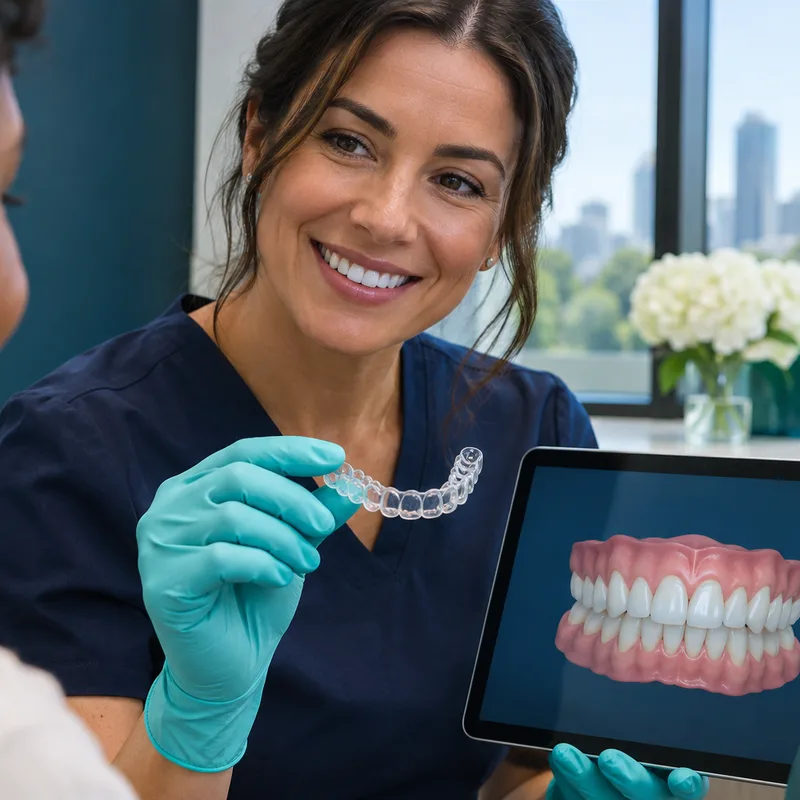
Clear aligner benefits
The transparent trays are less noticeable than metal brackets and wires, which can suit adults and teens who feel self-conscious about visible orthodontic appliances.
Aligners come out for meals, so there are fewer food restrictions. Removal also allows direct access to the teeth for brushing and flossing.
A digital treatment plan sets out the intended sequence of tooth movement. Your clinician reviews that plan rather than relying on a generic aligner schedule.
Scheduled evaluations confirm that the trays are tracking as intended and give your clinician an opportunity to adjust the plan when needed.
Retainers help hold the teeth in their corrected positions after active treatment. Long-term wear instructions are discussed before the aligner series is complete.
What to expect
The process begins with a review of your concerns, dental health, bite, and treatment goals. Records may include photographs, digital scans, and appropriate radiographs. Active decay or gum disease may need treatment before tooth movement begins.
Your records are used to plan the direction and sequence of movement. The clinician assesses the proposed outcome, attachment placement, spacing needs, and bite changes before authorizing aligner production.
At delivery, the fit is checked and any prescribed attachments are placed. You receive instructions for wear, cleaning, tray changes, storage, and handling common issues such as pressure during the first days of a new set.
Periodic visits assess tracking, tooth movement, and oral health. If progress differs from the digital plan, additional scans and refinement aligners may be recommended.
Once active movement is complete, retainers are used to reduce unwanted shifting. Retainer fit and the recommended wear schedule are important parts of protecting the result.
Treatment cost
Invisalign treatment in Atlanta typically ranges from about $3,500 to $8,000, although limited plans may cost less and involved bite correction may cost more. This is a general, nonbinding estimate rather than a quoted fee.
The final cost depends on case complexity, treatment length, the number of aligners, required attachments, refinements, and whether retainers or related records are included. Insurance benefits and payment arrangements also vary. Your exact fee and what it covers are confirmed after the clinical consultation and treatment-plan review.

Provider considerations
Choose a provider who evaluates more than whether the front teeth look straight. Tooth roots, gum health, jaw relationships, bite contacts, and long-term stability all affect treatment decisions. Ask who will create and monitor the plan, how progress is checked, what happens if aligners stop tracking, and whether refinements and retainers are included in the quoted fee.
A responsible evaluation should also identify cases that may be better treated with fixed braces or coordinated care. Clear aligners are useful, but they are not automatically the best appliance for every pattern of tooth movement. Patients with implants, bridges, active periodontal disease, or significant bite concerns may need additional assessment before starting.
For patients traveling between Buckhead, Brookhaven, and Midtown, the schedule for progress checks is worth discussing before committing to treatment. Ask how often in-person appointments are expected and how urgent concerns, lost trays, or damaged attachments are handled.
Aligners should be removed before eating and placed in their case rather than wrapped in a napkin. Before reinserting them, brush or rinse when practical and clean the trays according to the instructions provided. Hot water can distort aligner material, and abrasive toothpaste may leave clear trays looking cloudy.
Atlanta's long commutes and busy work schedules make preparation useful. Keep your current case and basic oral-hygiene supplies with you, especially when dining away from home. If you are flying through Hartsfield-Jackson Atlanta International Airport or traveling for several days, carry the current set and the previous set in your hand luggage. Your clinician can advise whether to advance to a new tray if travel overlaps with a planned change.
Mild pressure is common after changing to a new aligner, but severe pain, a sharp edge that injures tissue, or a tray that will not seat should be assessed. Do not force a poorly fitting tray or make an unapproved change to the schedule. Timely guidance can prevent a small tracking issue from affecting later aligners.
A personal evaluation can clarify whether Invisalign fits your bite, daily routine, and treatment goals before you commit to care.
Check AvailabilityCommon questions
You may be a candidate if your teeth and gums are healthy, your alignment concern can be treated predictably with clear aligners, and you can follow the prescribed wear schedule. A clinical examination and diagnostic records are needed because crowded teeth, spacing, and bite problems vary in complexity. Atlanta patients with untreated decay or active gum disease generally need those conditions stabilized before orthodontic tooth movement.
Treatment may take several months for limited movement and a year or longer for more involved alignment or bite correction. The number and difficulty of planned movements, wear consistency, biological response, missed visits, and the need for refinements all affect timing. Your Atlanta consultation should provide an individualized estimate after records have been reviewed.
Progress checks are commonly scheduled every several weeks, but the interval varies by treatment stage and clinical need. These appointments allow the provider to check tracking, attachments, bite changes, and oral health. Patients commuting to the 30305 area should ask for the expected visit schedule when reviewing their plan.
You should remove Invisalign aligners for meals and for beverages other than cool water unless your clinician gives different instructions. Eating with trays can damage or stain them, while hot drinks may distort the material. Brush or rinse before reinserting the trays when possible.
Contact the treating office promptly for instructions rather than moving ahead on your own. Depending on your progress, you may be told to wear the previous tray, advance to the next tray, or order a replacement. Atlanta travelers should carry their previous set as a backup and keep aligners in hand luggage.
Some dental plans include an orthodontic benefit that may apply to Invisalign, while others exclude adult treatment or set a lifetime orthodontic maximum. Coverage is determined by your specific policy rather than your Atlanta ZIP code. Ask for a written estimate that separates the treatment fee, expected insurance contribution, payment terms, refinements, and retainers.
Yes, retainers are normally recommended after active Invisalign treatment because teeth can shift throughout life. The initial and long-term wear schedule depends on your case and the type of retainer prescribed. Ask whether retainers and follow-up checks are included when comparing Invisalign fees in Atlanta.
Your Invisalign consultation
Schedule a consultation with Atlanta Cosmetic Dentists to discuss your alignment concerns, review the treatment process, and receive a personalized plan with clear expectations for timing and cost.