Single-Tooth Implant
One implant and a custom crown replace a missing tooth without using the adjacent teeth as bridge supports. Crown contours and shade are planned to fit the surrounding smile.
Serving Atlanta, Georgia & surrounding areas

Dental implants in Atlanta
Replace missing teeth with a treatment plan built around natural appearance, stable function, and your long-term oral health.
Implant dentistry
Dental implants in Atlanta, GA can replace one missing tooth, several teeth, or an entire arch. An implant is a biocompatible titanium post placed in the jawbone. After it integrates with the bone, it supports a crown, bridge, or implant-retained denture. Unlike a traditional bridge, a single-tooth implant generally does not require the neighboring teeth to be reshaped.
Atlanta Cosmetic Dentists begins with an examination of your teeth, gums, bite, and available bone. Digital imaging helps determine implant position and identify anatomical structures that affect planning. Our team also considers tooth shape, shade, gum contours, and how the restoration fits your smile rather than treating implant placement as an isolated procedure.
Our Buckhead ZIP code offers practical access for patients who live or work near Peachtree Road, while major routes connect the area with Midtown and communities across the northern metro. Because implant treatment involves several visits, convenience matters. The more important consideration, however, is a clear plan that explains each stage before treatment begins.
Candidate considerations
Many adults with missing or failing teeth may be candidates, but suitability must be confirmed clinically. Healthy gums, adequate jawbone, and the ability to heal normally support predictable treatment. The dentist also reviews your medical history, medications, tobacco use, prior dental work, and any history of gum disease.
Bone loss does not automatically rule out implants. Depending on its location and extent, grafting may help create a stronger foundation. In the upper back jaw, a sinus lift may be considered when there is not enough bone height beneath the maxillary sinus. Some patients need these procedures before implant placement, while selected cases allow grafting and placement during the same appointment.
Active infection and uncontrolled periodontal disease are addressed before treatment. Certain health conditions or medications can affect healing and require coordination with a physician. A responsible recommendation may be to proceed, complete preparatory care first, or consider another tooth-replacement option.
Treatment possibilities
One implant and a custom crown replace a missing tooth without using the adjacent teeth as bridge supports. Crown contours and shade are planned to fit the surrounding smile.
A bridge secured by implants can replace several adjacent teeth. The number and position of implants depend on bone, bite forces, and the length of the missing-tooth space.
Implants can improve denture retention and reduce movement during speaking and eating. The restoration may remain removable for cleaning, depending on its design.
A full arch of replacement teeth can be secured to strategically placed implants. Candidacy depends on bone distribution, oral health, restorative space, and medical factors.
What to expect
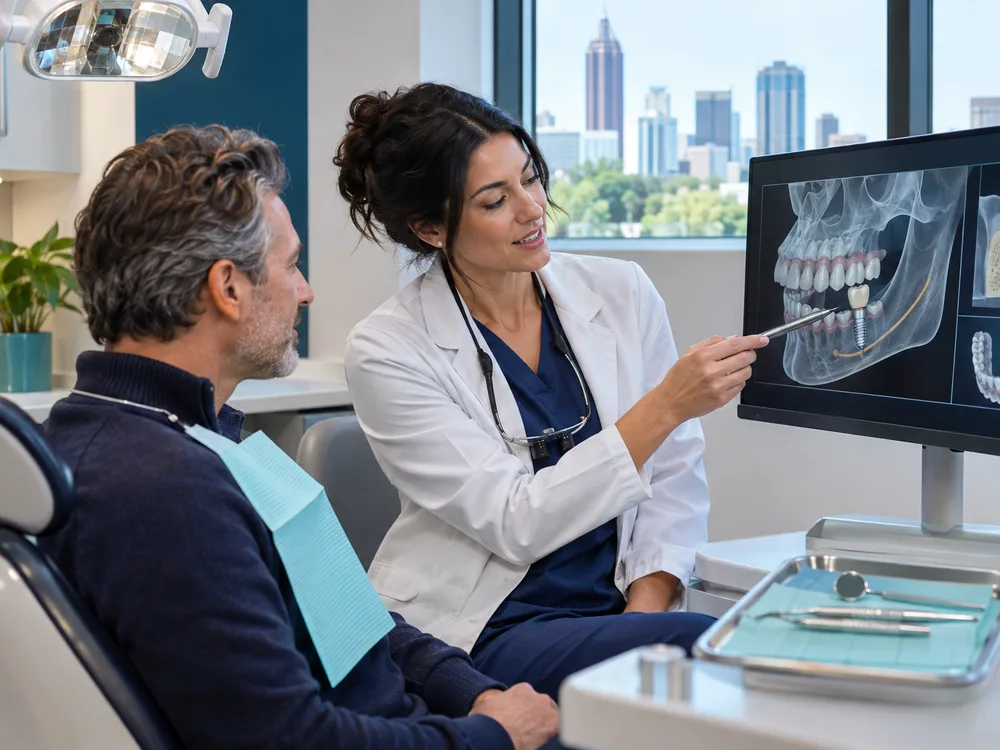
The dentist examines your mouth and reviews your goals, health history, and existing restorations. X-rays and, when appropriate, cone-beam computed tomography provide three-dimensional information about bone volume and nearby anatomy.
Your plan identifies the proposed implant location, type of restoration, expected sequence, and whether extraction or bone grafting is needed. You receive an explanation of alternatives and anticipated fees before committing to treatment.
The implant is placed in the planned position under appropriate local anesthesia. A cover screw or healing abutment protects the implant during early healing. Post-procedure instructions cover hygiene, diet, and activity.
Bone gradually bonds to the implant surface through osseointegration. Timing varies with implant stability, bone quality, grafting, health, and location in the mouth. A temporary tooth may be possible, but it must be protected from excessive biting pressure.
After integration is confirmed, records are taken for the crown, bridge, or full-arch teeth. The finished restoration is checked for appearance, contact with neighboring teeth, hygiene access, and bite balance.
Implants cannot develop cavities, but the surrounding gum and bone can become inflamed. Daily plaque removal and professional maintenance are necessary, and periodic imaging may be used to monitor bone levels.
Treatment costs
A single dental implant with its abutment and crown in Atlanta typically costs about $3,500 to $6,500. Bone grafting, extraction, sedation, or a temporary tooth can increase the total. Implant-supported bridges and full-arch restorations usually cost substantially more because they involve multiple implants and a larger prosthesis.
Final pricing depends on implant count, available bone, restoration material, laboratory work, treatment complexity, and whether preparatory procedures are required. Insurance benefits vary and may cover selected portions rather than the entire treatment. Your exact cost is confirmed after the consultation and diagnostic imaging.
Planning standards
The best dental implants Atlanta patients can choose are not defined by one implant brand or the fastest advertised timeline. Quality begins with diagnosis. The implant must be surrounded by appropriate bone, positioned to support the planned tooth, and aligned so the final restoration can be cleaned. Placement and restoration should be planned together.
Ask who completes each stage, what imaging is used, whether grafting may be required, and what temporary option is appropriate. You should also understand the restoration material, maintenance schedule, warranty terms if offered, and how complications are handled. A written plan should distinguish surgical fees, restorative fees, and possible additional procedures.
Appearance matters most in visible areas. The implant position, abutment design, crown shape, ceramic shade, and gum contour all affect the result. In back teeth, bite forces and cleansability carry particular weight. Every location requires a plan based on anatomy rather than a standard package.
Long-term care
A well-maintained implant can provide durable function, but it is not maintenance-free. Brush around the restoration daily and clean beneath bridges or around implant attachments with tools recommended for the design. Floss threaders, interdental brushes, or a water flosser may be useful when standard floss cannot reach the area effectively.
Keep regular examination and cleaning appointments. The clinical team checks the gums, plaque levels, bite, restoration components, and signs of inflammation. Persistent bleeding, swelling, discomfort, looseness, or a change in the bite deserves prompt assessment. Early evaluation can distinguish a gum problem from a loose screw, damaged restoration, or another concern.
Patients who clench or grind may need a protective night guard. Tobacco use can interfere with healing and raises concern for the tissues around implants. Good home care and management of health conditions remain important long after the final tooth is placed.
A focused implant consultation can clarify whether you are a candidate, which restoration fits your needs, and what treatment sequence to expect.
Check AvailabilityCommon questions
A straightforward implant case often takes several months from placement to the final restoration. Healing time depends on implant stability, bone quality, the treatment location, and whether extraction or grafting is involved. Some patients can receive a temporary tooth during healing, but immediate loading is appropriate only when clinical conditions support it.
Same-day extraction and implant placement may be possible when infection, bone anatomy, gum condition, and implant stability are favorable. It does not necessarily mean the permanent crown is placed that day. Three-dimensional imaging and a clinical examination are needed to determine whether immediate placement is appropriate.
A bone graft is needed only when the existing jawbone cannot adequately support the planned implant or restoration. Minor grafting may sometimes occur during implant placement, while larger defects often need a separate healing period. Cone-beam imaging can show bone width, height, and nearby structures more clearly than a standard two-dimensional X-ray.
Dental insurance may cover certain parts of implant treatment, but benefits vary by policy and are often subject to exclusions, annual limits, or waiting periods. A plan may contribute toward an extraction, graft, crown, or denture even if it excludes the implant fixture. The treatment estimate should separate each component so available benefits can be reviewed.
Implant placement is performed with anesthesia, so patients should not feel sharp pain during the procedure. Tenderness, swelling, or bruising can occur afterward and generally improves as healing progresses. The expected recovery depends on whether treatment also includes an extraction, graft, or multiple implants.
Implants may be possible after active gum disease is controlled and the supporting tissues are stable. Untreated periodontal infection can jeopardize the teeth and the tissues around an implant. The dentist will assess pocket depths, bleeding, bone levels, and home care before recommending placement.
Many patients return to nonstrenuous work within a short period, but recovery varies with the number of implants and whether grafting or extraction was performed. Atlanta patients who commute through high-traffic corridors may prefer to schedule a lighter day after surgery. Follow the specific guidance provided for exercise, diet, and medication.
Dental implants are intended as long-term tooth replacements, but no responsible clinician can promise a fixed lifespan. Longevity depends on tissue health, hygiene, bite forces, tobacco exposure, medical factors, and professional maintenance. The crown or other restoration may eventually need repair or replacement even when the implant remains integrated.
Your implant consultation
Share your concerns about missing or failing teeth. Atlanta Cosmetic Dentists can assess your oral health, review the available options, and prepare a clear treatment plan for your smile.